Kosher Wedding Catering in Miami: Winter Season Guide
Every October, my phone begins to ring with a very particular kind of joy. Miami's winter wedding season — those glorious months from November through April when the humidity lifts and the evenings turn golden — is when couples who dreamed all summer finally set their dates. And among the most meaningful calls I receive are from families planning kosher weddings. As a chef trained in Lyon and shaped by years alongside Alain Chapel and Pierre Hermé, I have come to believe that kosher catering is not a limitation on fine cuisine. It is an invitation to practice it with greater intention.
If you are planning a kosher wedding in Miami this season, here is what I have learned about doing it beautifully — from supervision and sourcing to the French techniques that make a kosher menu sing.
Why Miami's Winter Season Is Kosher Wedding Season
Miami has become one of the great destinations for Jewish weddings in America. Families fly in from New York, New Jersey, Los Angeles, and abroad, drawn by oceanfront venues, private estates, and yes — the possibility of a reception on the water in December. The winter months offer reliable weather for outdoor chuppahs, and Saturday night weddings after Havdalah become easier to orchestrate as sunset arrives early.
That popularity carries a practical consequence: the best venues, and the caterers equipped to execute a true kosher event at a luxury standard, are reserved months ahead. If your date falls between December and March, the time to secure your kosher catering team is now.
What Glatt Kosher Really Means for Your Menu
Many couples come to me with the same quiet worry: will keeping kosher mean compromising on elegance? Let me put that to rest. A proper kosher wedding simply demands discipline at every stage — and discipline is the soul of French cooking anyway.
A fully kosher event means certified sourcing for every ingredient, strict separation of meat and dairy from the first delivery to the last plate, dedicated or properly kashered equipment, and supervision by a mashgiach who oversees the kitchen throughout preparation and service. When a family requires glatt kosher standards, the sourcing of meats becomes more rigorous still. None of this is visible to your guests. What they see is a flawless reception; what happens behind the scenes is a choreography of care.
My advice: settle the level of kashrut early, in conversation with your families and your rabbi, and share it with your caterer before the menu is written. Every beautiful menu begins with clarity.
French Technique, Kosher Discipline
Here is where my training becomes your advantage. Classic French cuisine leans on butter and cream — but the deeper truth of the French kitchen is technique, not dairy. For a meat meal, I build sauces the way Alain Chapel taught me: patient reductions of wine and fond, emulsions mounted with olive oil, the brightness of citrus and fresh herbs doing the work cream once did.
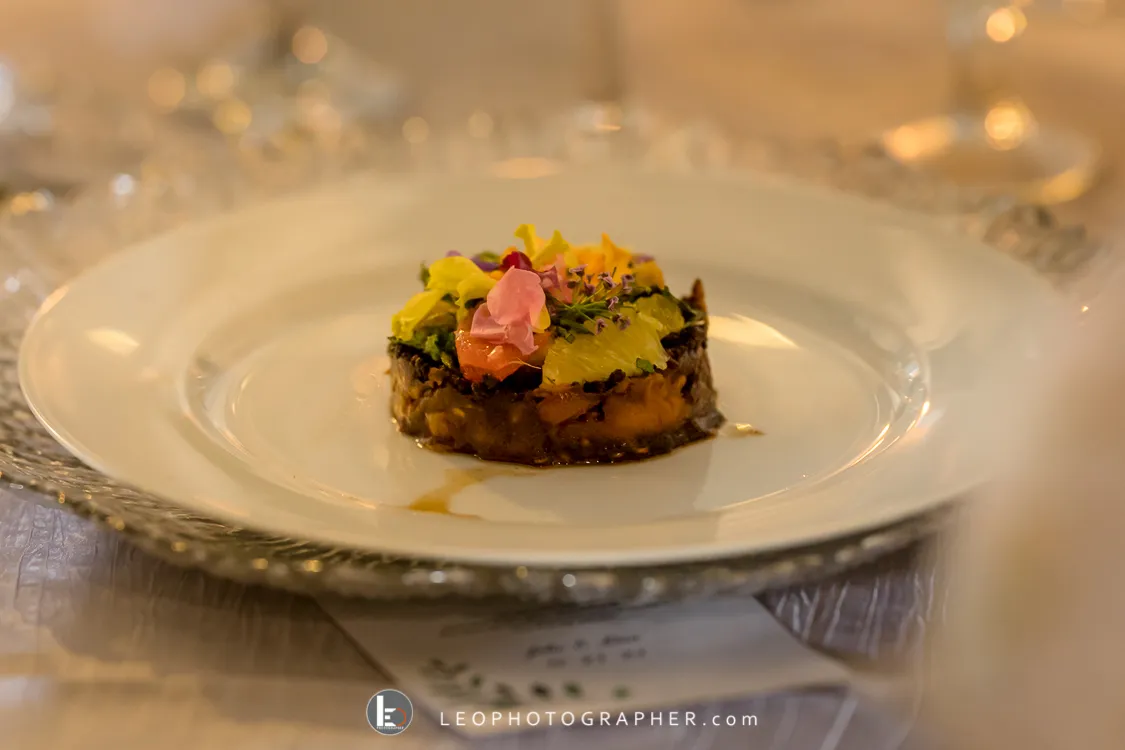
Picture a winter wedding menu: seared duck breast with a sauce of reduced pomegranate and Banyuls; herb-crusted rack of lamb carved at a live station; a first course of yellowtail crudo with Meyer lemon and espelette. For dessert — the domain where Pierre Hermé shaped my thinking — pareve patisserie can astonish: dark chocolate marquise, almond dacquoise, fruit so perfectly handled it needs no cream at all.
This is what luxury catering in Miami should mean for a kosher celebration: nothing that feels like a substitution, everything that feels like a choice.
Designing the Reception: Stations, Plated Courses, or Both
Jewish weddings carry their own rhythm — the ceremony, the cocktail reception while the couple takes portraits, the grand entrance, the hora before anyone has touched a fork. Your service style should honor that rhythm.
I often recommend a generous cocktail hour of passed canapés and live cooking stations, which keep energy high and guests mingling, followed by an elegant plated dinner once the dancing pauses. For families who prefer abundance, a sequence of stations through the evening works beautifully. For formal black-tie affairs, a full plated service of three or four courses brings the quiet drama of a fine restaurant to your wedding reception.
Timing Around Shabbat and the Jewish Calendar
A kosher wedding is planned with the calendar in one hand. Saturday evening weddings must begin after Shabbat ends, which in a Miami winter can be as early as 6:30 pm — workable, even wonderful. Sunday remains the most popular choice for winter celebrations. Your caterer must also plan preparation around Shabbat itself: nothing can be cooked on Saturday for a Saturday night event, so the mise en place, the staffing, and the kitchen timeline all shift. An experienced kosher catering team treats these constraints as simply another part of the craft.
Frequently Asked Questions
Can a kosher wedding menu still feel French and refined?
Absolutely. French cuisine is a method before it is a set of ingredients. Reductions, emulsions, precise cooking, and seasonal sourcing translate fully into kosher cooking — meat or dairy, and certainly glatt kosher. My menus are written course by course with each family, never from a template.
How far in advance should we book kosher wedding catering in Miami?
For the winter season — November through April — I recommend six to nine months ahead for full weddings, and no less than three months for intimate celebrations. Kosher events require extra coordination with supervision and sourcing, so earlier is always wiser.
Do you work with our rabbi or preferred kosher supervision?
Yes. We coordinate directly with your rabbi or supervising agency and welcome the mashgiach into our kitchen as a partner. The standard of kashrut is your family's decision; executing it impeccably is ours.
Let's Plan Your Celebration
A kosher wedding in Miami can be everything you have imagined: rooted in tradition, radiant with hospitality, and cooked with the precision of a French kitchen. I would be honored to be part of yours. Request a quote for your date, or call me directly at +1 786-307-1675 — and let's begin writing your menu together.


